
7 page types AI bots love and 3 they ignore (2026)
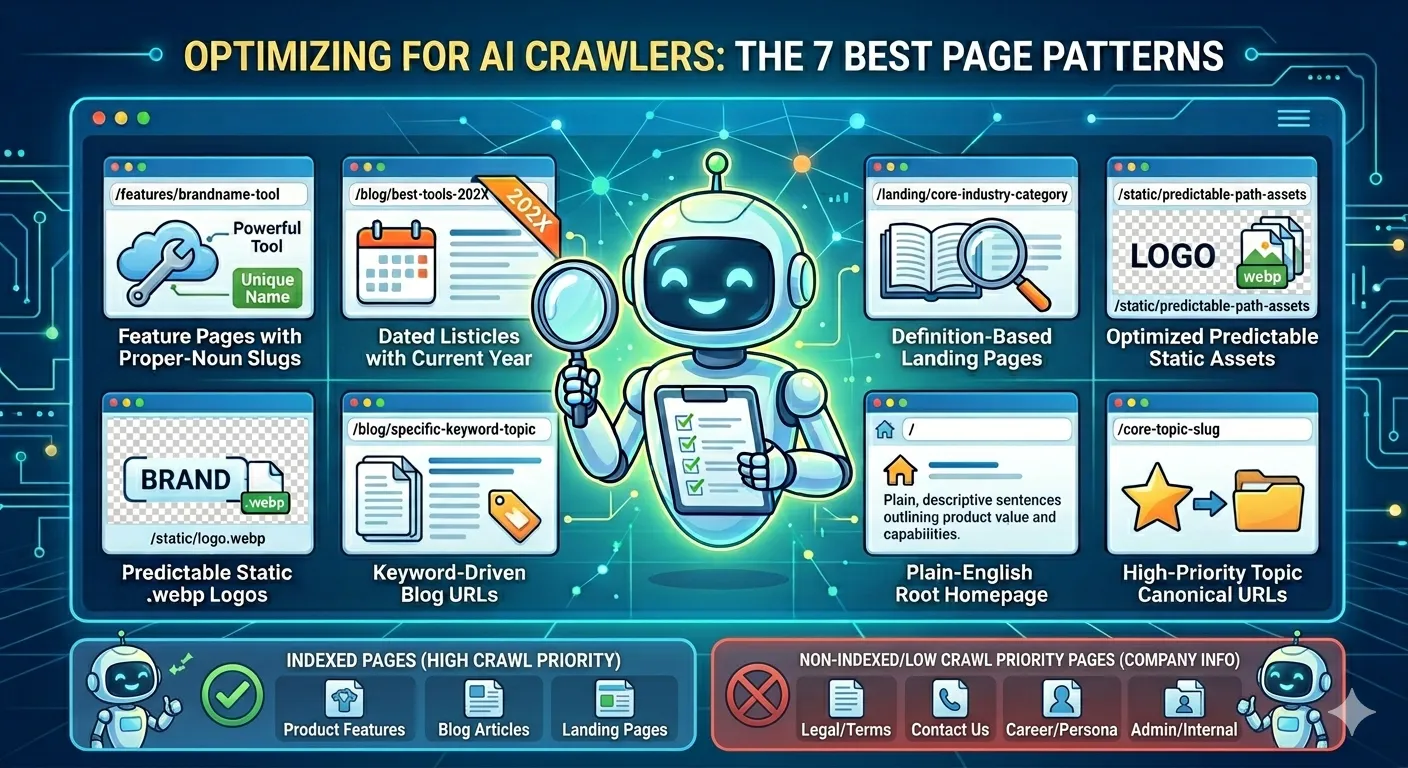
We watched 6 AI bots crawl trendos.io for a few days in mid-May 2026, pulling from IIS basic logs and Cloudflare logs. The pattern of which pages they pulled (and which they completely ignored) was sharper than expected. Here are 10 takeaways from that data, ranked by how clearly the pattern showed up.
To protect our own traffic numbers, we share the page-type pattern as ratios and percentages, not counts. The shape of what gets pulled vs. ignored is the part you can act on.
The 7 page types AI bots love
1. Feature pages with proper-noun slugs
GPTBot's entire crawl in the window was a tight set of /features/<product-name> URLs (/features/chatgpt-visibility-tracker, /features/real-time-competitor-alerts, /features/gemini-visibility-tracker). The pattern is unmissable. Pages with a competitor or product name baked into the slug get crawled. Generic feature names like /features/analytics do not.
What to do: rename your feature URLs to include the proper noun a real user would search for. /features/shopify-integration beats /features/integrations. Every time.
2. Dated listicles with the year in the slug
ChatGPT-User pulled /blog/ecommerce-competitive-intelligence-tools-2026. A model that sees a 2026 in the URL has a strong hint that the content is current. That signal matters when the user just asked "what are the best X tools right now?"
What to do: put the current year in your listicle slug, and refresh the URL when the year rolls over (with a 301). The SEO purists hate this. The AI traffic does not care.
3. Landing pages with category-keyword URLs
ChatGPT-User pulled /landing/ecommerce-competitive-intelligence. The slug is just the category phrase, no fluff. The model treated it as a definitional answer source.
What to do: build a landing page per category keyword you want to win. URL equals the keyword, content equals a real definition plus your product fit. Skip the marketing prose at the top; lead with the definition.
4. Static webp logos
Meta AI grabbed /static/logo.webp. AI assistants increasingly compose visual answer cards (think chat replies with brand thumbnails). If your logo file is named final-logo-v3.png and buried under /wp-content/uploads/2023/05/, no AI is finding it.
What to do: put a clean, square, transparent-background .webp logo at a predictable path like /static/logo.webp, and reference it in your Schema.org Organization markup. Your logo is a product asset, not a decoration. Treat the file accordingly.
5. Blog posts under /blog/<keyword-rich-slug>
ChatGPT-User pulled /blog/ecommerce-competitive-intelligence-tools-2026. Same listicle as item 2, but the broader point is that /blog/ as a directory works fine when the slug underneath it is keyword-heavy. Date-based slugs like /2026/05/17/post-title give the model far less to grab onto.
What to do: drop date-based blog URL structures. Move to /blog/<keyword-slug> and 301 the old paths. Old date-based slugs are dead weight. Cut them this quarter.
6. The root homepage
Both top live-answer crawlers in our sample (ChatGPT-User and Meta AI) pulled /. The homepage is still the entry point models use when they want to identify what a brand does.
What to do: the first 500 words of your homepage should describe your product in plain language a model can summarize back to a user. Not a brand mission statement. Not a hero tagline only. Plain sentences a chatbot can quote without editing.
7. Comparison-style URLs at the root
ChatGPT-User pulled /ecommerce-competitive-intelligence. No /landing/ prefix, no /blog/, just the topic as a top-level URL. That signals "this is the canonical page for this topic on this domain". Models prefer canonical.
What to do: for your highest-priority comparison or category topic, give it a top-level URL. Do not bury it three folders deep. If users type the keyword into Google, the URL is /keyword. Not /solutions/category/keyword.
The 3 page types AI bots ignored completely
8. Index pages (e.g., /personas/)
Zero AI bots fetched any index page in our window. Index pages (think /personas/, /categories/, or any landing that just lists other pages by audience or theme) are organizing artifacts for your sales site. Real users do not type "list of pages for marketers" into ChatGPT. They type "marketing tool for X". The index page is the wrong shape for that query.
What to do: either consolidate index pages into use-case or topic pages with concrete keyword slugs like /use-cases/track-competitor-ads, or accept that index pages are sales infrastructure and not an AI surface. Both choices are honest. Pretending index pages will rank in AI is not.
9. /solutions/* pages
Same story. Solutions pages are written in vendor-speak. ("Transform your competitive intelligence workflow." Nobody types that into ChatGPT. Nobody.) Zero AI bots fetched a single /solutions/* URL on our site in the window. Zero.
What to do: rewrite the most important solution page as a feature page or a comparison page, with a slug that names the thing it does. Move on from the solutions taxonomy if AI traffic is the goal.
10. Static contact and legal pages (e.g., /contact, /privacy)
Not one hit on any of these. AI bots do not care about your legal pages or static support pages. They are answering questions, not filling out forms.
What to do: stop trying to make pages like /contact rank in AI surfaces. The right job for them is to convert humans who already landed on your site from somewhere else. Optimize for conversion, not for AI. Same with the legal pages, which only exist because your lawyers said so.
The pattern is bigger than the data
This is a few days of data from one B2B SaaS site, pulled from IIS basic logs and Cloudflare logs. Directional, not statistical. We will re-run this every month. If the pattern shifts, we will publish it. If it holds, you will know your URL audit was worth the time. Either way, AI bots want pages that look like answers. If your URL structure was designed for a sales site taxonomy and not for "what would a user type", you have work to do.
For the longer-form analysis of the same dataset, see our companion post how AI bots really crawl your site.
The takeaway
AI bots love pages that look like answers and ignore pages that look like sales artifacts. Audit your URL structure against this 10-item list before you ship your next feature page.
See which page types are pulling AI bot traffic on your domain
The Trendos AI Visibility tracker watches which AI bots hit which pages on your site, surfaces the gaps vs. your named competitors, and tells you which 3 pages to ship next. 10 minutes with us, real coffee or pretend coffee. We pull your last 30 days of AI bot traffic before the call. You will see your gaps against competitors before we say a word about Trendos.
Book a 10-minute coffee